Our Services
High Voltage Cable Condition Testing
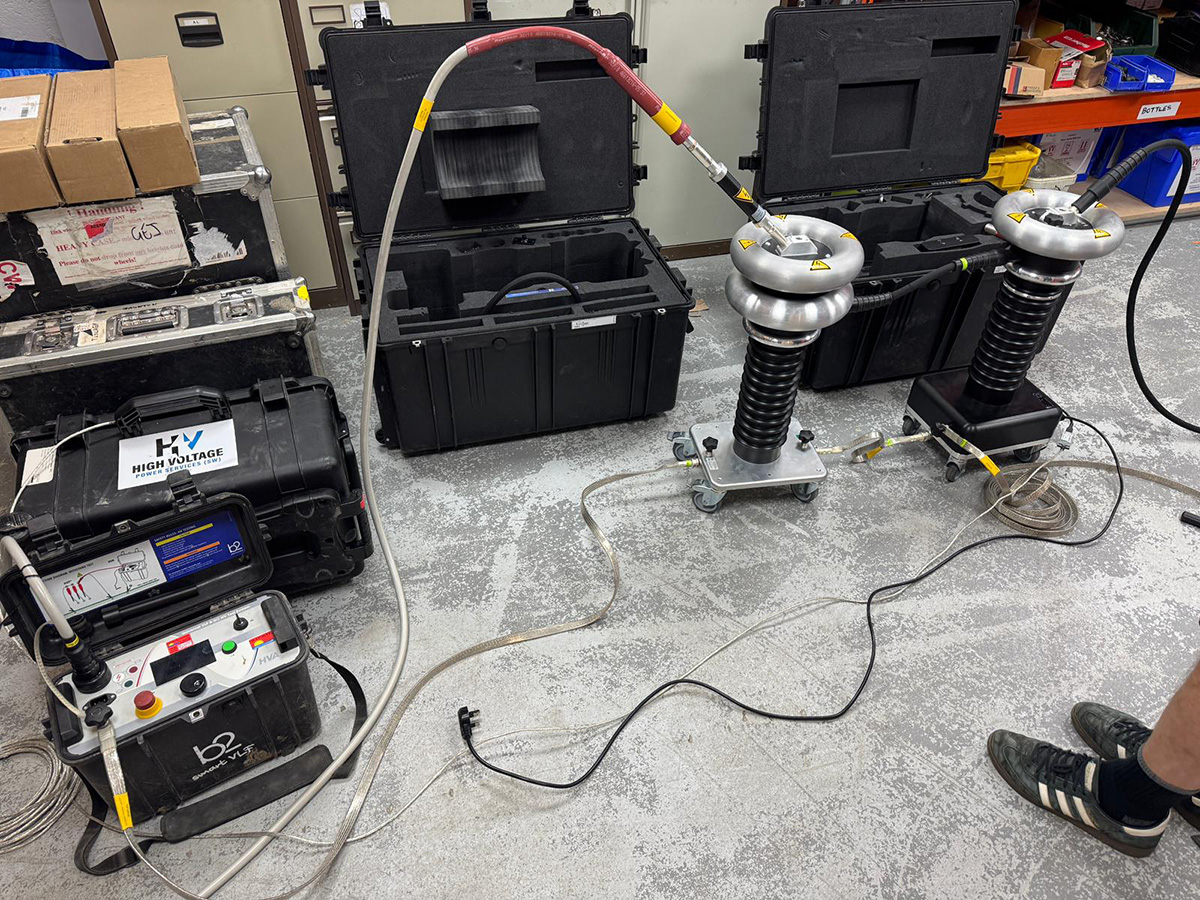
High Voltage Power Services (HVPS) undertake High Voltage cable condition testing and is used to assess the health of power cables and detect insulation degradation before failure occurs. These tests are essential for utilities, industrial plants, and large facilities where cable failure can cause major outages. Below is a structured overview of the main HV cable condition testing methods.
1. Offline Testing (Cable De-energized)
These tests require the cable to be taken out of service.
A. Insulation Resistance (IR) Test
- Uses a megohmmeter (Megger)
- Measures resistance between conductor and ground
- Indicates gross insulation problems
- Quick but not very diagnostic for aging
B. Very Low Frequency (VLF) Testing
- Applies AC voltage at ~0.1 Hz
- Used for:
- Withstand testing
- Tan Delta (dissipation factor) measurement
- Common for medium-voltage cables (e.g., 11 kV, 33 kV)
C. Tan Delta (Dissipation Factor) Test
- Measures dielectric losses
- Detects:
- Water trees
- Insulation aging
- Contamination
- Widely used for XLPE cables
D. Partial Discharge (PD) Testing – Offline
- Detects localized insulation defects
- Identifies:
- Voids
- Cracks
- Termination/joint defects
- Can pinpoint defect location with time-domain reflectometry
2. Online Testing (Cable Energized)
Performed while the cable is in service.
A. Online Partial Discharge Monitoring
- Uses:
- HFCT (High-Frequency Current Transformers)
- TEV sensors
- Continuous or periodic monitoring
- Ideal for critical feeders
B. Thermal Imaging
- Uses infrared cameras
- Detects:
- Hot joints
- Poor connections
- Overloading
- Often used in substations
3. Diagnostic vs Withstand Testing
Modern best practice favours diagnostic testing (PD, Tan Delta) over purely withstand testing.

4. Typical Test Selection by Cable Type
XLPE Cables
- VLF Tan Delta
- Offline PD
- Sheath testing
PILC (Paper Insulated Lead Covered)
- DC testing (limited use now)
- Tan Delta
- PD testing
5. Additional Specialised Tests
- Sheath Integrity Testing – Detects jacket damage
- Time Domain Reflectometry (TDR) – Locates faults
- Dielectric Spectroscopy (FDS) – Detailed insulation analysis